Featured

Everything is subjective

One man’s trash is another man’s treasure, and the by-product from one food can be perfect for making another.

Yotam Ottolenghi

We don’t judge here at This Is Boring. This is a site that explores things that people do for fun, and fun is subjective. For example, we write a blog about boring hobbies. Does that sound fun? To us it does. The discovery, the research, the absolute passion that goes into something that people do in their time off is fascinating. You know what is boring to us? Not having a hobby at all.

Sit back and pull up a random link. We can’t promise that you’ll find something here that sparks an interest but you will likely learn something about a hobby that you didn’t even know existed.

Letterboxing

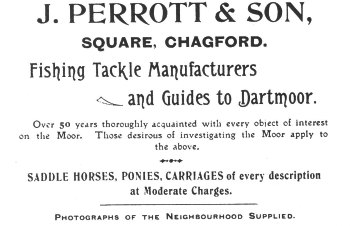
Have you ever been so bored that you wrote yourself a letter, mailed it, and tried to be surprised when it showed up in your mailbox? James Perrott of Chagford, England was a guide who led adventurous visitors across the Dartmoor wilds in the 1800’s. Dartmoor was (and still is) a boggy expanse dotted with hills topped with outcrops of bedrock that attracted (and still does) nature-lovers looking to commune. Most of it was pretty dangerous for the average hiker back then so James offered his knowledge of the local routes and points of interest.

This ad looks like it belongs at the beginning of a horror story.

In 1854, he piled up a bunch of rocks out in the moor and stuck a bottle on it. The intent was to have travelers place their calling cards inside…a much cooler version of putting your business card in a bowl in hopes of a free burrito. Eventually somebody added a visitor’s book and eventually a stone box was constructed in order to protect the contents from the muggy climate. This began the world-wide hobby of Letterboxing…searching for treasure via clues left by previous visitors.

trespassers
Survivors will be shot again. Haw haw haw.

Today, Letterboxing has a large community of enthusiasts who both like to hide and seek. Several websites host clues, discussions, and a community for those folks and are generally very welcoming to new fans of the hobby. Do note that there is a Code of Conduct to this pastime. Safety is always a concern so be aware of your surroundings; you shouldn’t cross into private property to reach your particular goal because that’s quite illegal. Explorers also tend to be mindful of the environment because like hiking, it is expected that no trace is left…other than a colorful stamp which you’ll read about later. Nobody wants to find rudely discarded bottles and granola wrappers on their adventures. Finally, keep an eye on the local flora and fauna. Poisonous plants and venomous animals love to letterbox also, not to mention the huge Bear Letterboxer Community.

letterbox
If you can’t figure out how to make a stamp, grab a GPS unit and go Geocaching instead, loser.

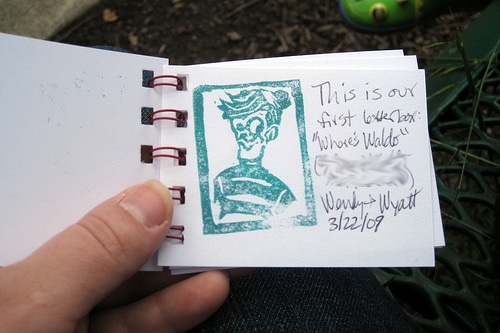
A huge part of the Letterbox hobby adds some personal flair. Inside the secret cache is usually a logbook which visitors mark their passing. This is often in the form of a pressed-image stamp. This ranges from a store-bought Hello Kitty to family crests and personal logos. The most popular method is to carve your own stamp from rubber that takes a bit of crafting , a bit of creativity, and a bit of flair. These intrepid explorers bring the stamp, ink, spare notebooks, and some ratty old clothes suitable for entering the Moors.

Back when letterboxing began, hikers would leave letters and postcards in hidden areas in the hopes somebody would find it and mail it off. Sometimes they were self-addressed and it would be delivered months or years later as a sort of message from the past. Modern enthusiasts have a more speedy gratification; finding that logbook, looking over the inked images of previous explorers, and adding their own. It’s a nifty low-tech hobby that gets you out into the world with an eye for the hidden treasures out there.

Rubbing Brass

Visiting historical monuments while on vacation isn’t an unusual thing. Plenty of parents drag their kids along while trying to convey the historical significance of the Battle of the Hague or hike around the beautiful El Morro National Momument. You probably even brought a nice camera to record the experience for posterity. But what really kicks things down a notch is bringing along butcher’s paper and graphite to furiously scrub at a significant carving a like a homemade mimeograph machine.

Rubbing is arguably a British thing. Commemorative ceramic discs dot the country, called Blue Plaques , that honor notable persons and serve as historical markers by linking them to notable buildings. There are over 900 in London and subjects span the spectrum of Theorists to Karl Marx. Finding them can be quite a scavenger hunt which is a hobby in its own right.

Remember that scene from Indiana Jones and the Last Crusade where he and the hot Nazi historian (spoiler) found that tomb and had to hide inside while the gasoline-filled catacombs were set set on fire? The rubbing from Sir Richard’s shield eventually led to the Holy Grail somehow. Brass Rubbing is like that but way less exciting.

For our purposes, this side-quest gets specific. Brass Rubbing refers to engraved metal memorials usually crafted beginning in the 13th century that can be found in churches. These are usually smaller and cheaper than a stone statue but can be pretty fragile so check with your local vicar before you get to rubbing. We recommend the crypt of St. Martin-In-The-Field.

This pastime is very sensory. There is the engraving’s relief to see, of course, as well as the feel of the material’s cool and embossed texture. Also, the echoed scrubbing of a wax stick in the silence of an old English church is an experience nobody should miss out on.

You can actually try it out now with a pad of paper and a pencil. Write a note on the top sheet, tear it off, and eat it. Take the pencil and gently color the next page with the flat side of the graphite. Put the paper in your scrapbook. Congratulations, you solved the case!

Taking Surveys For Fun

One of first notable use of questionnaires goes back to France, 1835. Adolphe Quetelet was a man that was born with an unusual amount of curiosity. His interests spanned everything from astronomy to sociology, including something called Anthropometry…meaning he was really into the physical proportions of his fellow Frenchmen. Or Frenchwomen.

He also gathered data about people’s psychology. Social Physics was about trying to figure people out like we would try to figure out anything with hard science. Why does an apple fall when you drop it? Scientific Method says it’s gravity. What’s a good way to spray Diet Coke dozens of feet into the air? Scientific Method says it’s Mentos. What does the average Frenchman of the 1830’s eat for breakfast? Scientific Method says Revolution.

This study took answers from many people across the country, what we’d call Big Data today, and tried to explain societal norms. Fast forward to today, and marketers now know that subtle media manipulation makes kids think smoking is fun.

OK, that’s an extreme case. But I’m sure you’re not surprised to know that you’ve been categorized by geography, income, education, and spending habits into something called Segmentation. Survey data is a two-edged sword because it’s also benefiting public health and childcare.

So who takes surveys for fun? Extremely bored people, for one. You literally clicked on a link to an article about the boring hobby of filling out surveys. One theory suggests it’s about cost vs reward. Plenty of websites offer gift cards if you tell them about the last movie you watched. You can get free fish by telling Long John Silver’s about your latest customer experience.

Another theory called Cognitive Dissonance suggests that some people feel a compulsion to click those links and answer calls because they want to help or feel anxious about the decision to participate.

Then there are the people who want their opinions to be heard. It doesn’t matter what the subject is, as long as it’s out there floating in space for someone to react to. You know those places. Reddit. Quora. 4chan. Our personal favorite, Fark.

questionaire social science survey zerohero

We consider habitually participating in surveys a hobby. Either via the cold, impersonal interface of a computer or the fleeting interpersonal conversation over the phone…it passes the time and keeps you off the streets.